




For quantitative engineering teams, algorithmic trading developers, and systematic risk desks exploring native probabilistic intelligence, explore Seneca's hosted continuous forecasting architecture or apply for early access to Seneca forecasts at nautilus.finance to acquire Model Context Protocol API credentials.
In systematic quantitative engineering, the hidden tax that quietly destroys developer velocity is context switching. An engineer writing execution algorithms or testing smart contract liquidation boundaries does not operate in a vacuum. They write code inside a command line shell, toggle over to a proprietary charting terminal, check spot price action in a browser tab, and paste static price assumptions back into unit tests. By the time market data enters the local development cycle, it is already stale, disconnected from live microstructure, and stripped of probabilistic reality.
At Nautilus Labs, our quantitative research engineering focuses on replacing intuitive guesswork, static heuristics, and lagging technical indicators with empirical probability surfaces derived by the Seneca foundational model. Institutional desks, proprietary trading firms, and autonomous agent developers can apply for early access to Seneca forecasts at nautilus.finance to acquire streaming credentials, or explore live multi-quantile prediction intervals directly on our platform.
With Anthropic's release of Claude Code, the developer command line has evolved from a passive syntax execution pipe into an active, autonomous software engineering agent. Yet without structured access to live mathematical distributions, even frontier reasoning models remain fundamentally blind to market uncertainty. By implementing the open Model Context Protocol over streamable HTTPS, Seneca can now be mounted directly into Claude Code with a single shell command, granting active terminal sessions real-time quantitative reasoning capabilities without local daemon overhead.
1. The Universal Model Context Protocol Standard
Most financial AI integrations to date suffer from severe architectural compromises. They rely on brittle web-scraping scripts, complex headless browser automations, or static API aggregators that break whenever JSON schemas shift. More critically, when foundation models operate without structured access to verified market state, they hallucinate asset quotes, invent directional conviction, or regurgitate outdated commentary memorized during static pre-training cycles.
The Model Context Protocol, pioneered by Anthropic as an open specification, solves this coordination breakdown by standardizing how client agents discover, negotiate, and query external quantitative capabilities. Rather than building custom wrapper code for every individual agent framework, MCP establishes a universal contract. Tools, resources, and prompt templates are declared with explicit JSON schema definitions, allowing client models to inspect tool capabilities dynamically at runtime and formulate mathematically precise function arguments.
Crucially, Nautilus Labs engineered Seneca's Model Context Protocol interface to operate over streamable HTTPS rather than requiring local process spawns. In high-throughput algorithmic environments, forcing quants and engineers to clone private repositories, maintain Python virtual environments, or run memory-heavy background daemons introduces unneeded attack surfaces and operational friction. With hosted remote transport, any MCP-compliant client negotiates TLS handshakes, authenticates via bearer tokens, and streams live probability surfaces in milliseconds.
In modern cloud environments, developers must maintain strict credential segregation. Seneca's hosted gateway honors standard OAuth2 and Bearer token protocols, seamlessly reading authorization parameters from local environment variables without writing secrets to persistent terminal history. As a result, quants can deploy autonomous trading scripts across remote compute clusters with absolute confidence that model interaction credentials remain securely encapsulated.
2. Claude Code CLI: Zero-Daemon Terminal Mounting
Anthropic's Claude Code terminal interface represents a paradigm shift for software engineers. Operating directly in macOS and Linux shells, Claude Code can inspect multi-thousand-line repositories, run test suites, resolve dependency conflicts, execute git commits, and orchestrate complex build tools autonomously. However, until now, integrating live financial market intelligence into an active CLI development loop required complex bespoke scripting.
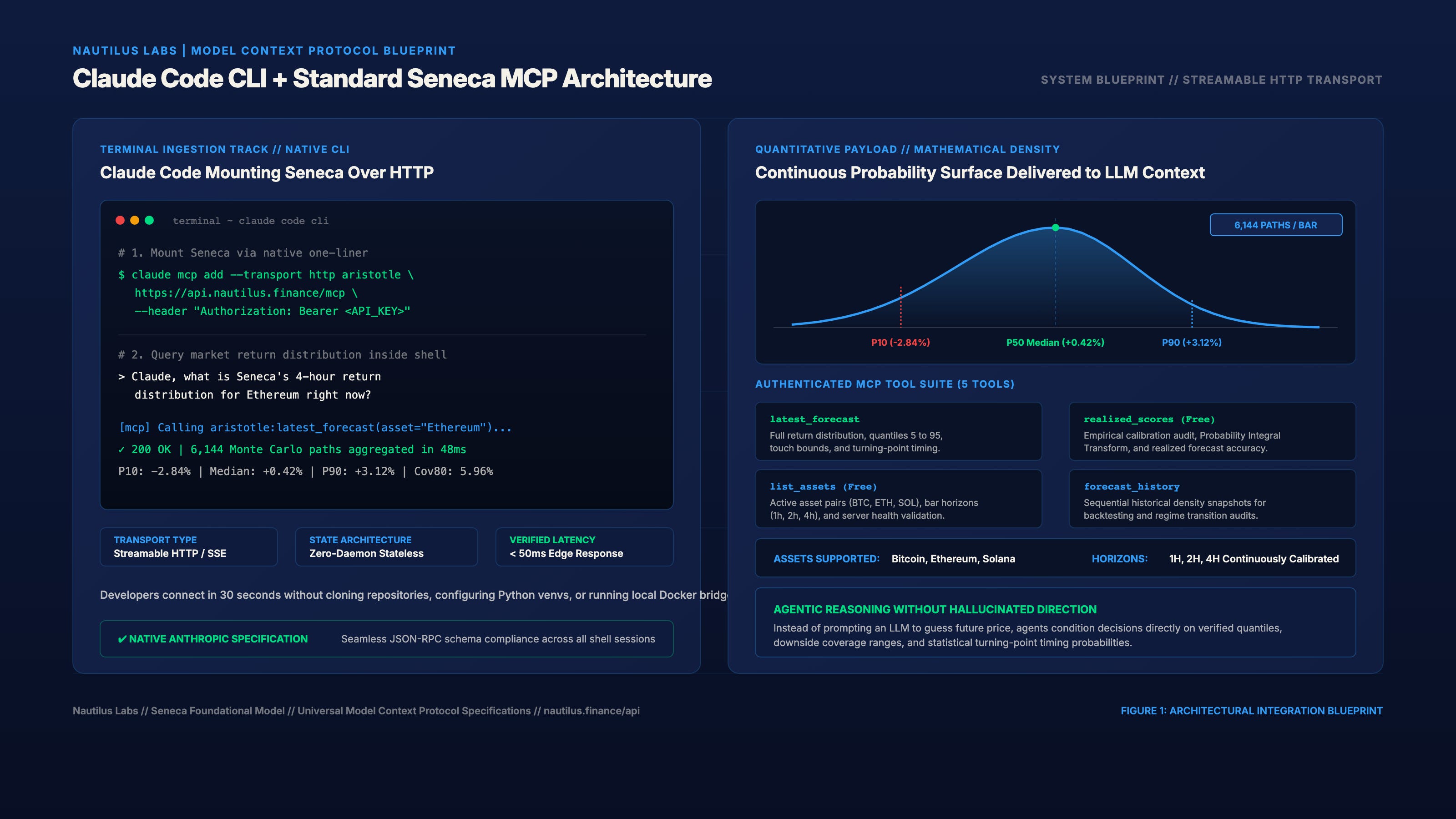
Because Seneca natively supports streamable HTTP transport, developers can connect their active Claude Code environment to our high-throughput forecasting engine with a single execution:
claude mcp add --transport http aristotle https://api.nautilus.finance/mcp --header "Authorization: Bearer <API_KEY>"For institutional engineering teams managing shared repositories, this configuration can also be committed directly into project-level configuration manifests. Once the server definition is registered, running Claude Code's standard capability discovery instantly surfaces Seneca's active quantitative endpoints without requiring a shell reboot or client restart.
The agent immediately gains programmatic access to calibrated Bitcoin, Ethereum, and Solana forecast distributions. An engineer debugging an automated execution bot can ask Claude Code to verify whether the current market regime permits tight limit order placement, and the agent queries live quantitative models directly before modifying local order routing parameters.
Beyond individual interactive queries, developers can chain Seneca MCP calls directly within Claude Code pipeline automations. By configuring project-specific prompts and custom shell aliases, quants can trigger pre-commit hooks that automatically evaluate algorithmic parameters against prevailing probability surfaces before code changes are committed to the main branch.
3. Continuous Probability Geometry vs. Static Price Signals
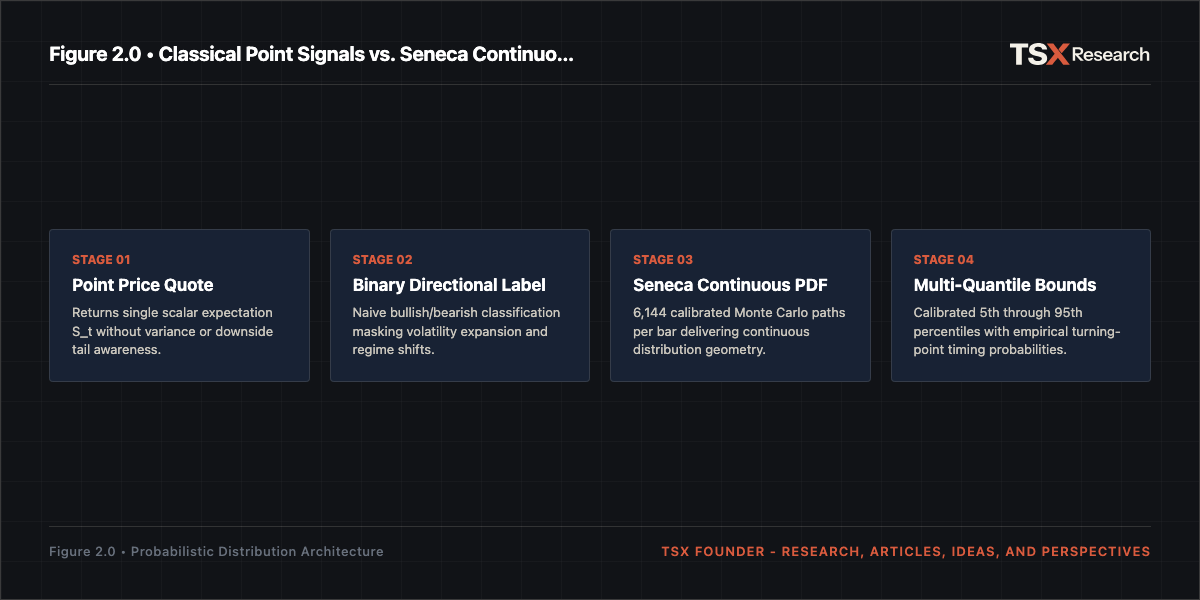
Traditional financial market APIs return static point prices, discrete volume snapshots, or naive binary sentiment flags. When an autonomous software agent attempts to reason about capital allocation or risk boundaries using point estimates, it suffers from severe systemic vulnerabilities. A binary forecast indicating that an asset has positive expected drift conveys zero information regarding whether the downside tail has expanded by three hundred basis points.
To understand why point estimates fail autonomous agents, consider the classical mathematical formulation of market state. In a naive point forecast model, expected price is represented as a single scalar expectation:
E[S_{t+Δt} | F_t] = S_t · exp(μ Δt)
This scalar formulation completely conceals volatility clustering, kurtosis expansion, and distributional skewness. In contrast, the Seneca foundational model generates continuous probability density functions aggregated across 6,144 calibrated Monte Carlo paths per bar:
f(S_{t+Δt} | F_t) = (1 / M) Σ δ(S_{t+Δt} - S^{(m)}_{t+Δt})
When Claude Code executes a forecast query through the hosted MCP gateway, it does not receive a flat price guess. It ingests complete statistical parameters: median drift expectation, multi-quantile bounds spanning the 5th through 95th percentiles, calibrated 80 percent prediction intervals, and empirical turning-point timing probabilities across institutional crypto assets. This structural geometry allows the agent to calculate variance-adjusted sizing, verify downside tail coverage, and enforce strict capital preservation constraints deterministically.
Furthermore, Seneca's continuous forecast surfaces explicitly capture non-Gaussian tail behavior, including negative skewness and leptokurtic shocks often observed during sudden liquidity drains. When an autonomous agent evaluates an execution decision using complete distribution geometry rather than static Gaussian approximations, it naturally avoids placing oversized bids during fragile microstructure regimes.
4. Zero-Credit Verification and Calibration Audits
In institutional financial engineering, trusting unverified probabilistic claims is organizational negligence. Before any machine learning model is integrated into production capital pipelines, its historical calibration curve must be rigorously verified across high-volatility regimes.
Seneca's Model Context Protocol endpoint includes dedicated verification tools that return empirical reliability curves, continuous ranked probability scores, and historical coverage ratios. An empirical 80 percent prediction interval is only mathematically valid if exactly eighty out of every one hundred historical market outcomes fall between its lower and upper boundaries. If realized prices breach the boundary thirty percent of the time, the model is underestimating variance and inviting catastrophic drawdown.
Because these verification endpoints are natively exposed via MCP, developers can instruct Claude Code to audit forecast reliability directly within their terminal. The agent can query trailing calibration tables, verify coverage statistics across liquidity flushes, and programmatically adjust downstream risk multipliers before committing algorithmic execution strategies to production codebases.
5. Concrete Quantitative Workflows Inside Claude Code
To illustrate the practical power of terminal-native probabilistic intelligence, consider three production workflows enabled by mounting Seneca into Claude Code:
Dynamic Slippage and Liquidity Boundary Verification: When authoring decentralized exchange routing logic, an engineer can prompt Claude Code to simulate worst-case price excursions over the next four hours. Claude Code queries Seneca's 5th percentile quantile bound, compares it against on-chain liquidity depth, and automatically configures protective slippage tolerances directly inside the smart contract test suite.
Automated Algorithmic Execution Hedging: During algorithmic rebalancing, quants can instruct Claude Code to inspect active order book exposure. By evaluating Seneca's directional turning-point probabilities and tail asymmetry metrics, the agent can write and execute an automated delta-hedging script that mitigates downside drift prior to scheduled macroeconomic volatility events.
Continuous Backtesting Sanity Checks: Developers constructing backtesting suites can have Claude Code validate synthetic market data against Seneca's empirical distribution surfaces. If historical simulation paths deviate significantly from empirical distribution kurtosis, the agent highlights the discrepancy and refactors the Monte Carlo generator to preserve authentic market microstructure.
In high-stakes decentralized ecosystems, automated liquidations occur deterministically according to smart contract state. By integrating continuous probability surfaces into developer test environments, teams can simulate thousands of concurrent liquidation cascades before deploying capital to mainnet protocols. This eliminates systemic blind spots that have historically caused catastrophic protocol insolvencies.
6. Conclusion: The Terminal Becomes Probabilistically Native
The convergence of frontier coding agents and high-throughput probabilistic foundation models is redefining quantitative software engineering. Developers no longer need to bridge fragmented terminals, brittle browser scrapers, or static spreadsheets to understand where market risk is accumulating.
By mounting Seneca directly into Anthropic's Claude Code via the Model Context Protocol, the developer shell transforms into a live probabilistic cockpit. Engineers receive calibrated distributions, multi-quantile boundaries, and verified downside risk geometry directly alongside their compilers, linters, and version control tools.
To equip your autonomous engineering workflows with live probabilistic intelligence, apply for early access to Seneca forecasts at nautilus.finance and mount our hosted Model Context Protocol gateway into your development environment today.
For custom enterprise integrations, multi-seat API gateways, or bespoke quantitative modeling inquiries, connect directly with the Nautilus Labs research desk.