![crypto[native]](https://substackcdn.com/image/fetch/$s_!baju!,w_120,h_120,c_fill,f_webp,q_auto:good,fl_progressive:steep/https%3A%2F%2Fsubstack-post-media.s3.amazonaws.com%2Fpublic%2Fimages%2Fc94827b0-d403-4ff4-a1dc-b507623bbbd2_1000x1000.png)

My publishing cadence got body-checked by the very thing founders ask for: traction.
Seneca moved from “interesting platform” to “clear the calendar, the machine is working” mode. Seneca is performing extraordinarily well, allocator interest continues to build, and trade volume is scaling month over month.
The fun part: the platform is working.
The less romantic part: growth comes with venue integrations, risk reviews, capital conversations, and enough operational details to make a sane person reconsider artisanal farming.
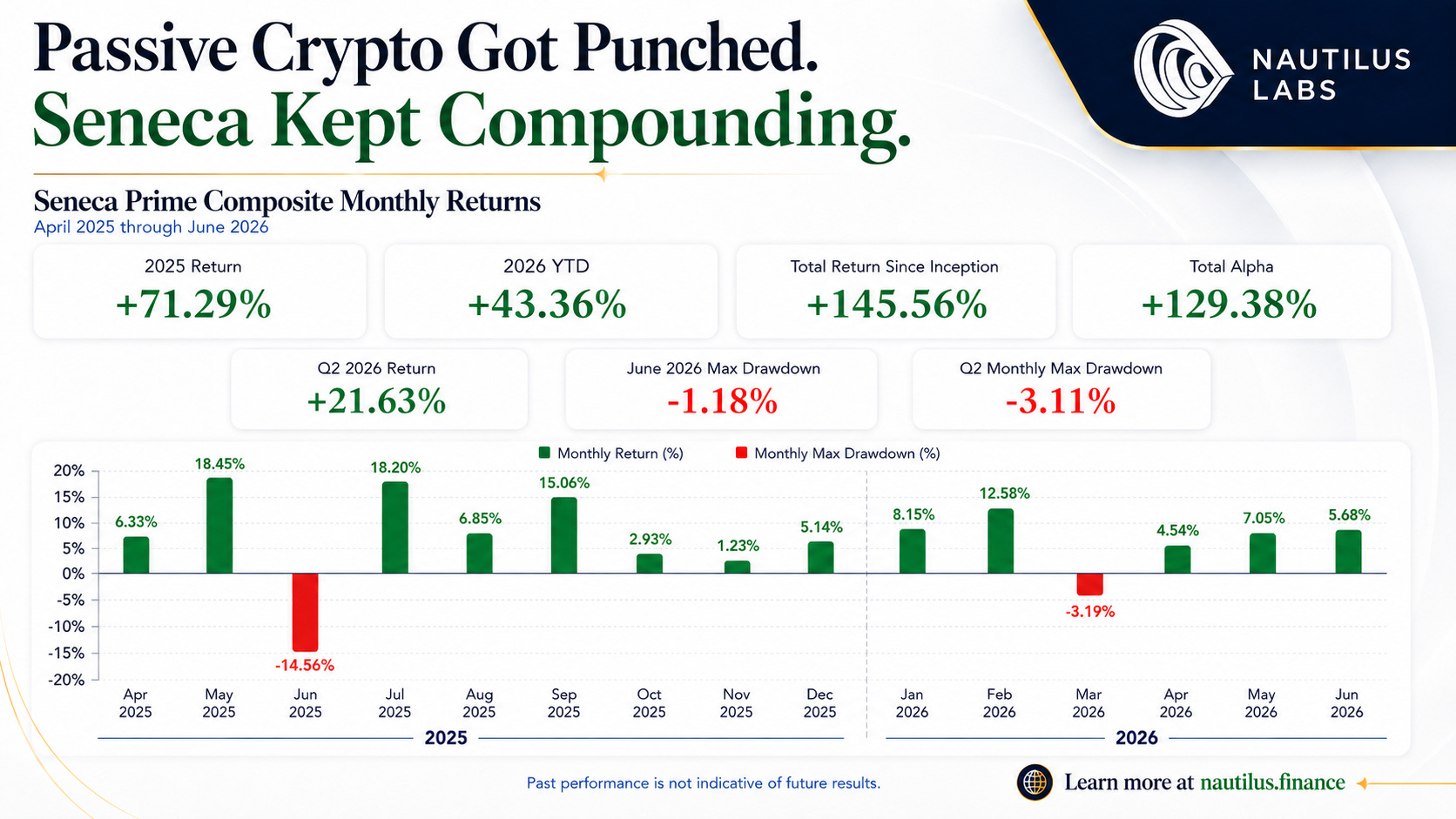
Seneca Prime Composite, Nautilus Labs’ flagship BTC, ETH, and SOL strategy, continued to perform through a difficult Q2 market environment for digital assets. Institutional de-risking, ETF outflows, valuation pressure, weaker sentiment, and macroeconomic uncertainty weighed on passive crypto exposure throughout the quarter.
Against that backdrop, Seneca generated +21.63% in Q2 2026, following +17.86% in Q1, while average monthly max drawdown improved from -6.48% in Q1 to -3.11% in Q2. June was a particularly strong example of the strategy’s risk profile, generating +8.70% monthly performance with only -1.18% max drawdown.
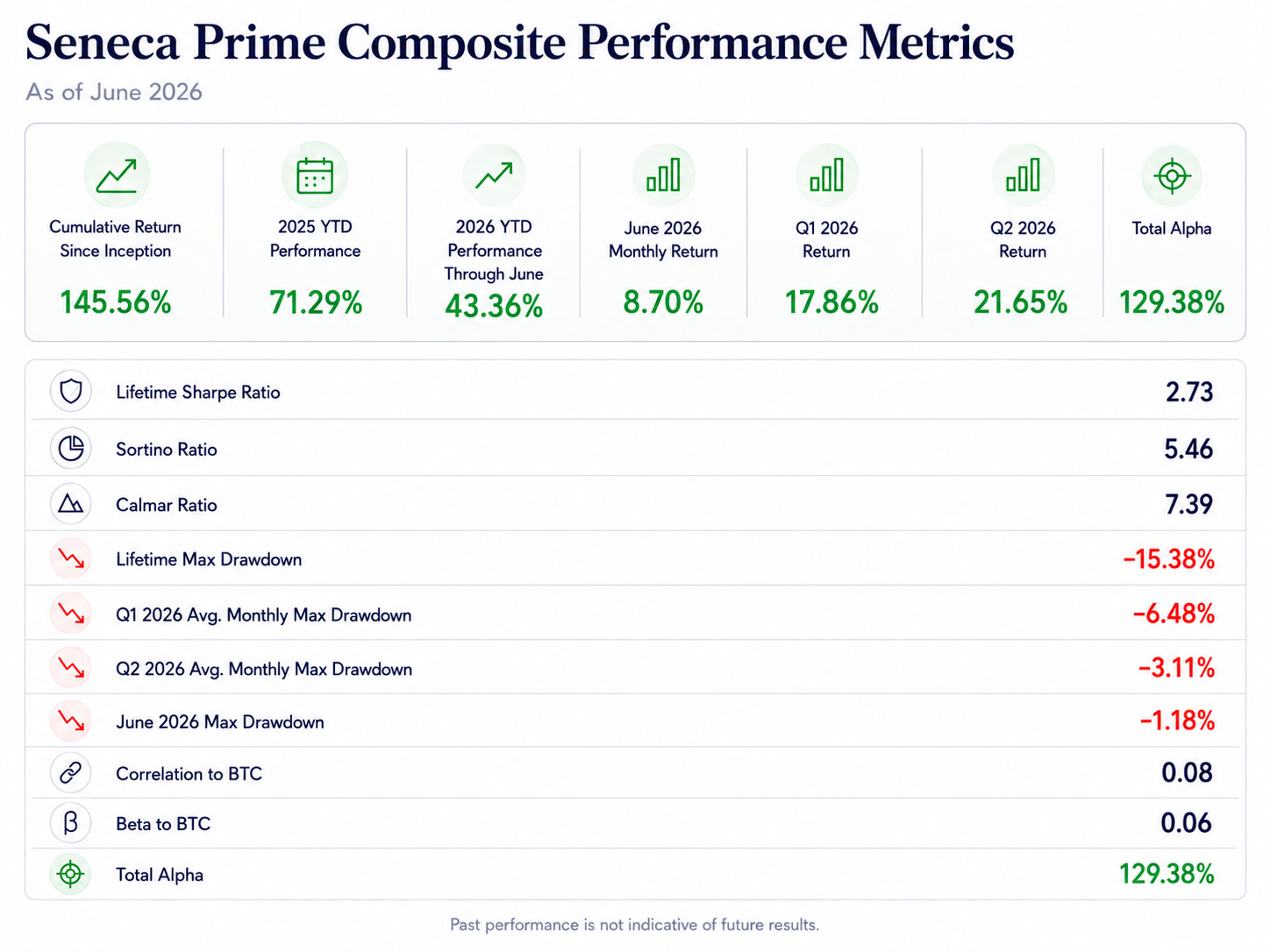
Since inception in April 2025, Seneca Prime Composite has generated +145.56% cumulative return and +129.38% total alpha relative to the underlying buy-and-hold benchmark. In 2025, the strategy generated +71.29%, and through June 2026, it has generated +43.36% YTD.
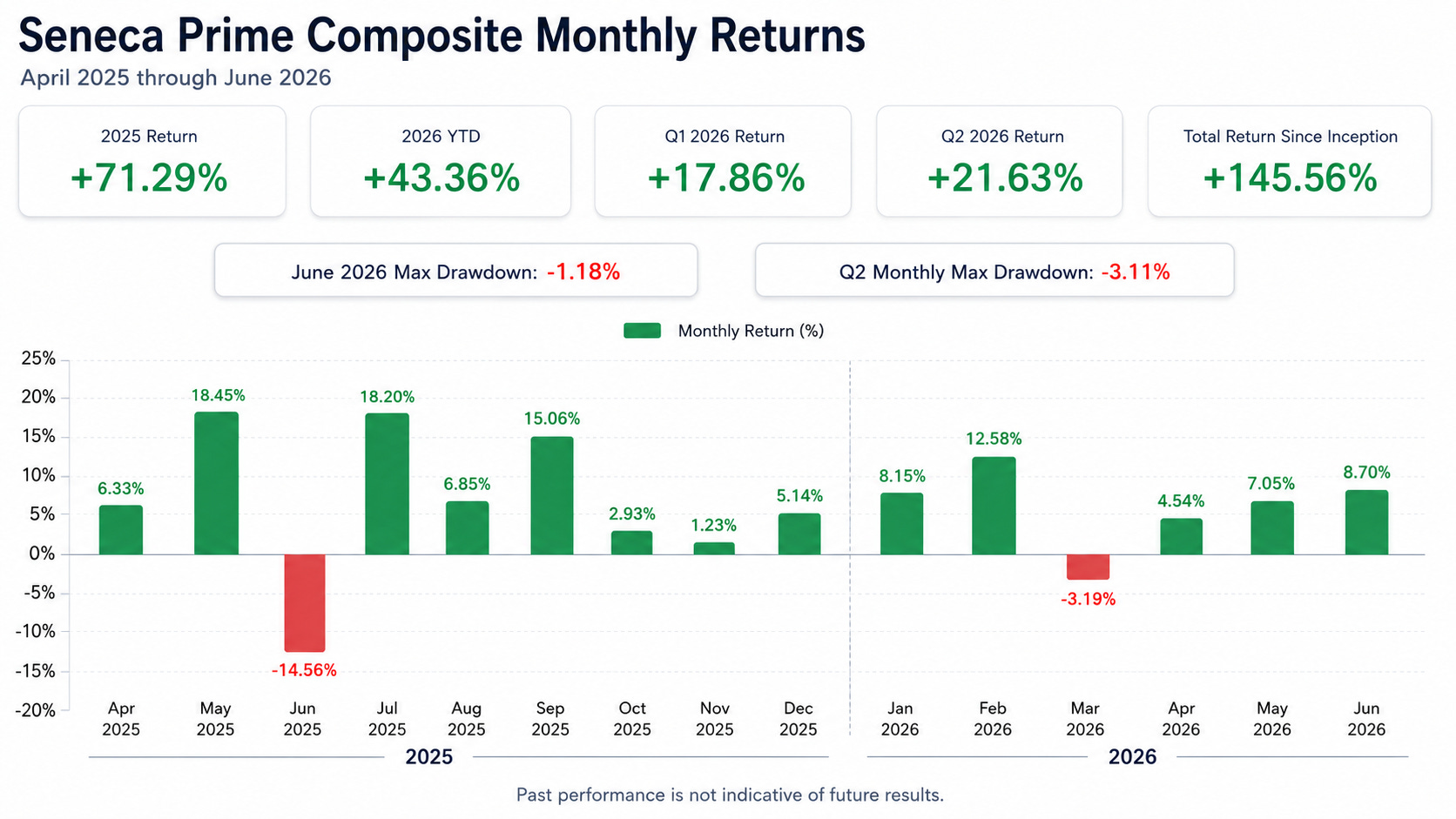
The Numbers Before the Narrative
Seneca Prime Composite has continued to perform across multiple market regimes, including periods where the underlying buy-and-hold benchmark experienced meaningful drawdowns.
Risk Was the Real Story in Q2
Returns are important. Risk-adjusted returns are the actual game.
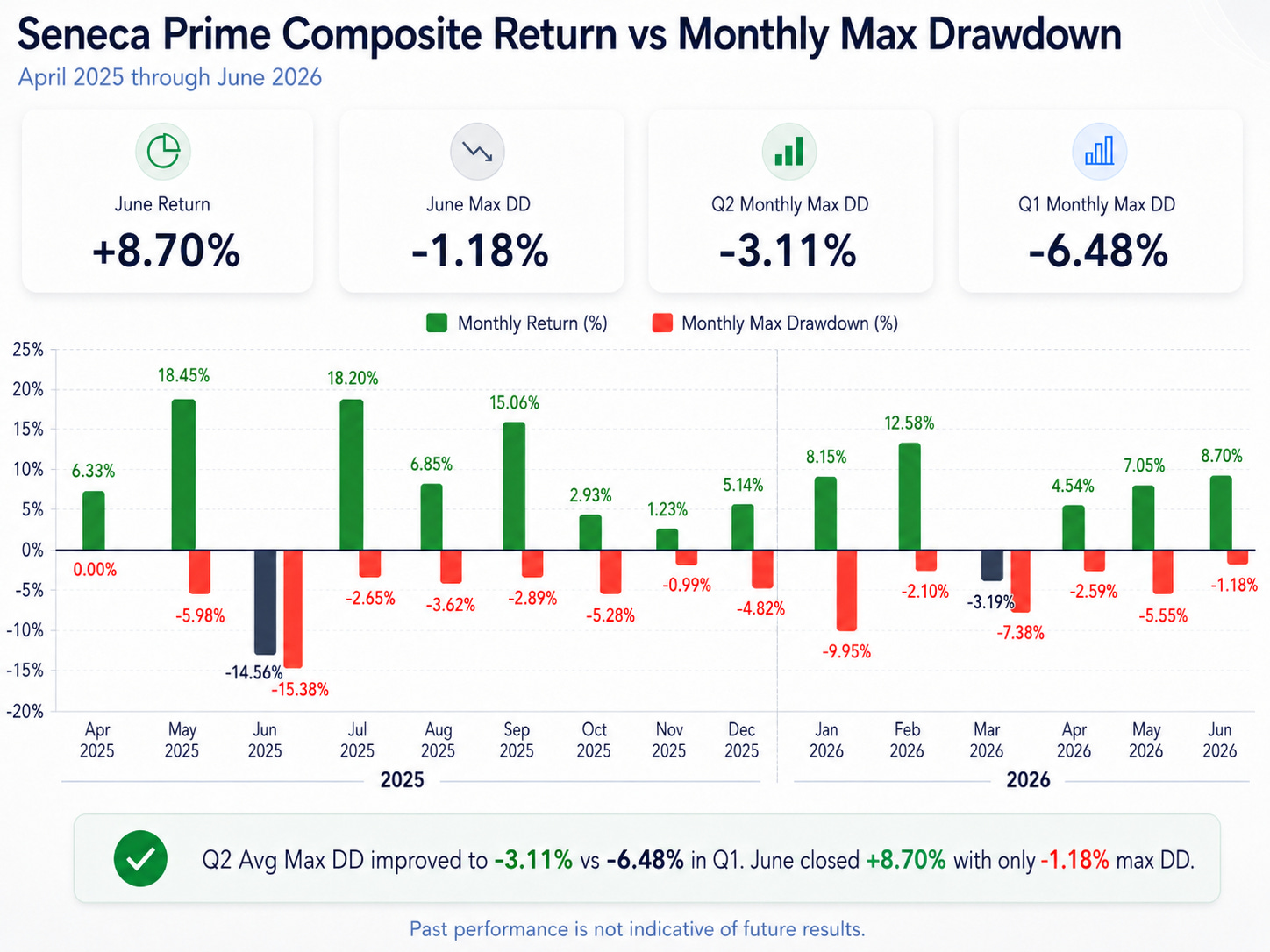
In Q1 2026, Seneca Prime Composite generated +17.86% with an average monthly max drawdown of -6.48%. In Q2 2026, the strategy generated +21.63%, while average monthly max drawdown improved to -3.11%.
Better return. Lower average monthly drawdown. In crypto, that is not supposed to be the easy part.
June made the point even clearer: +8.70% return with only -1.18% max drawdown. That combination matters because it shows Seneca is not simply capturing upside during favorable markets. It is producing returns while managing volatility and limiting downside exposure.
Q2 was a useful stress test. Passive exposure faced pressure from institutional de-risking, ETF outflows, weaker sentiment, and macro uncertainty. Seneca generated positive performance, improved its drawdown profile versus Q1, maintained low beta and correlation to BTC, and continued to compound alpha relative to the underlying buy-and-hold benchmark.
That is the core point: Seneca is built to interpret market regimes, not blindly absorb them.
Built for Regimes, Not Narratives
Nautilus Labs is an AI research lab focused on proprietary time-series forecasting and systematic trading.
Our core platform, Seneca, was built over four years of R&D and has now been live in production for approximately 15 months, operating through multi-billion-parameter ensembles designed for autonomous financial markets.
Seneca is not simply a signal strategy.
It is an AI platform that generates regime-aware strategies via our proprietary transformer architecture, AI workflows, and data pipeline.
Scaling Beyond a Signal
Seneca is now entering its next phase of scale.
Allocator interest continues to build, trade volume is growing month over month, and venue expansion is underway to support improved execution, deeper liquidity access, broader distribution, and larger strategy allocations.
Seneca signals are distributed via API and can be deployed through SMA structures in collaboration with venue partners.
At 1x leverage, Seneca trade volumes have grown to approximately 77x notional capital, with strategies capable of trading up to 4x leverage as deployment scales.
This creates substantial venue volume alongside positive P&L unit economics.
Why Passive Exposure Was Not Enough
Relative to a simple buy-and-hold benchmark across the same BTC, ETH, and SOL asset universe, Seneca Prime Composite has delivered materially stronger performance with substantially lower market sensitivity.
Since inception, the strategy has generated +129.38% total alpha while maintaining a 0.08 correlation to BTC and 0.06 beta to BTC.
That decoupled profile reflects Seneca’s core objective: capturing asymmetric upside while reducing exposure to structural market drawdowns.
Q2 Was the Stress Test
Q2 provided a clear example of Seneca’s design in action.
While passive crypto exposure faced meaningful pressure, Seneca generated +21.63% in Q2, improved average monthly max drawdown to -3.11%, and ended June with +8.70% performance against only -1.18% max drawdown.
The takeaway is simple: Seneca is not built to ride the market.
It is built to interpret market regimes, adapt, and pursue asymmetric returns while managing volatility and drawdown risk.
Entering the Next Phase
We are actively engaging with allocators, venue partners, and strategic collaborators as Seneca enters its next phase of scale.
Please reach out if you would like to discuss participation.
Learn more at nautilus.finance. Follow Nautilus Labs on LinkedIn.
Performance metrics reflect the Nautilus Intelligence Engine Q2.26 Seneca Prime Composite tear sheet and internal monthly drawdown analysis. Past performance is not indicative of future results.