




The transition from conversational AI to autonomous agentic execution represents the defining structural shift of modern computational finance. Large language models (LLMs) have achieved world-class proficiency at parsing complex sentiment, synthesizing regulatory filings, and generating algorithmic boilerplate. Yet, when deployed directly into live market microstructure, these systems routinely experience catastrophic failure modes. They hallucinate point targets, freeze during non-linear volatility spikes, and execute catastrophic orders because they operate on next-token heuristics rather than physical market distributions.
Autonomous quant agents require mathematical guardrails, physics-grounded probability density surfaces, and sub-millisecond execution verification. Connecting reasoning agents powered by the OpenAI Responses API, Claude Code, or Codex CLI to Seneca via our hosted Model Context Protocol (MCP) server bridges the chasm between generative language reasoning and deterministic market physics.
The Structural Failure of Deterministic Heuristics in Stochastic Regimes
Traditional algorithmic trading architectures rely on rigid rule-based heuristics. A moving average crossover, a mean-reverting Bollinger Band, or a machine-learning regression model trained on historical pricing generates an execution trigger when a threshold is crossed. While effective in stationary environments, these deterministic triggers inevitably fail during structural market breaks. Financial returns exhibit severe fat tails, volatility clustering, and extreme skewness. Modeling price action as an idealized Gaussian distribution or a deterministic point forecast leads directly to underestimating downside risk by orders of magnitude.
When autonomous reasoning agents are tasked with making independent portfolio allocations, they inherit these exact structural weaknesses unless explicitly constrained by calibrated probabilistic boundaries. An agent prompting an uncalibrated LLM for a Bitcoin directional forecast will receive a confident narrative supported by cherry-picked technical indicators. If the agent executes capital based purely on that narrative, it absorbs unhedged downside exposure with zero comprehension of the underlying tail risk.
Architectural Synthesis: Model Context Protocol as Institutional Interface
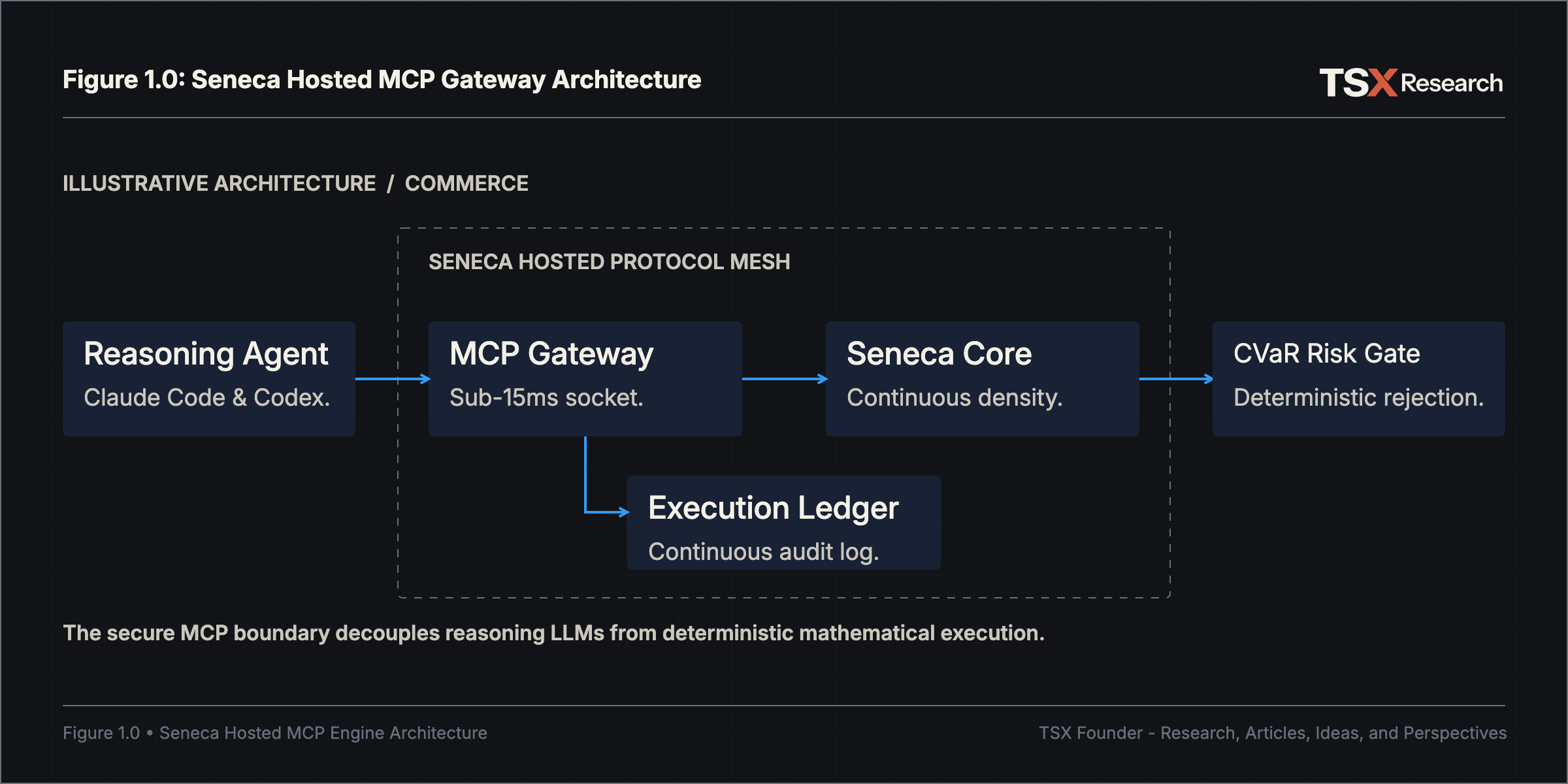
The Model Context Protocol (MCP) has emerged as the open institutional standard for securely connecting cognitive reasoning agents to external data pipelines and deterministic execution tools. Rather than building proprietary, brittle API scrapers for every agent framework, MCP provides a unified JSON-RPC protocol over standardized transports. Agents discover available tools dynamically, query schema definitions, and execute structured requests with guaranteed parameter validation.
By hosting a dedicated Seneca MCP gateway, quantitative development teams can expose real-time probability distributions, continuous calibration surfaces, and institutional Value-at-Risk (VaR) calculations directly into agent toolchains. When an agent running inside Claude Code or an automated Codex CLI loop encounters an allocation mandate, it does not formulate an ungrounded guess. Instead, it issues a deterministic tool call to Seneca for continuous forecast distribution parameters.
The gateway returns fully evaluated probability densities, parameter variances, and empirical quantiles derived from live order book dynamics and non-Gaussian volatility surfaces.
Continuous CVaR Gates: Turning Generative Output into Bounded Institutional Risk
To operate safely within institutional trading mandates, cognitive agents must be subjected to mathematical risk gates that supersede prompt instructions. A common architectural vulnerability in generative agents is prompt injection or stochastic drift, where an LLM inadvertently circumvents position size limits during anomalous market conditions.
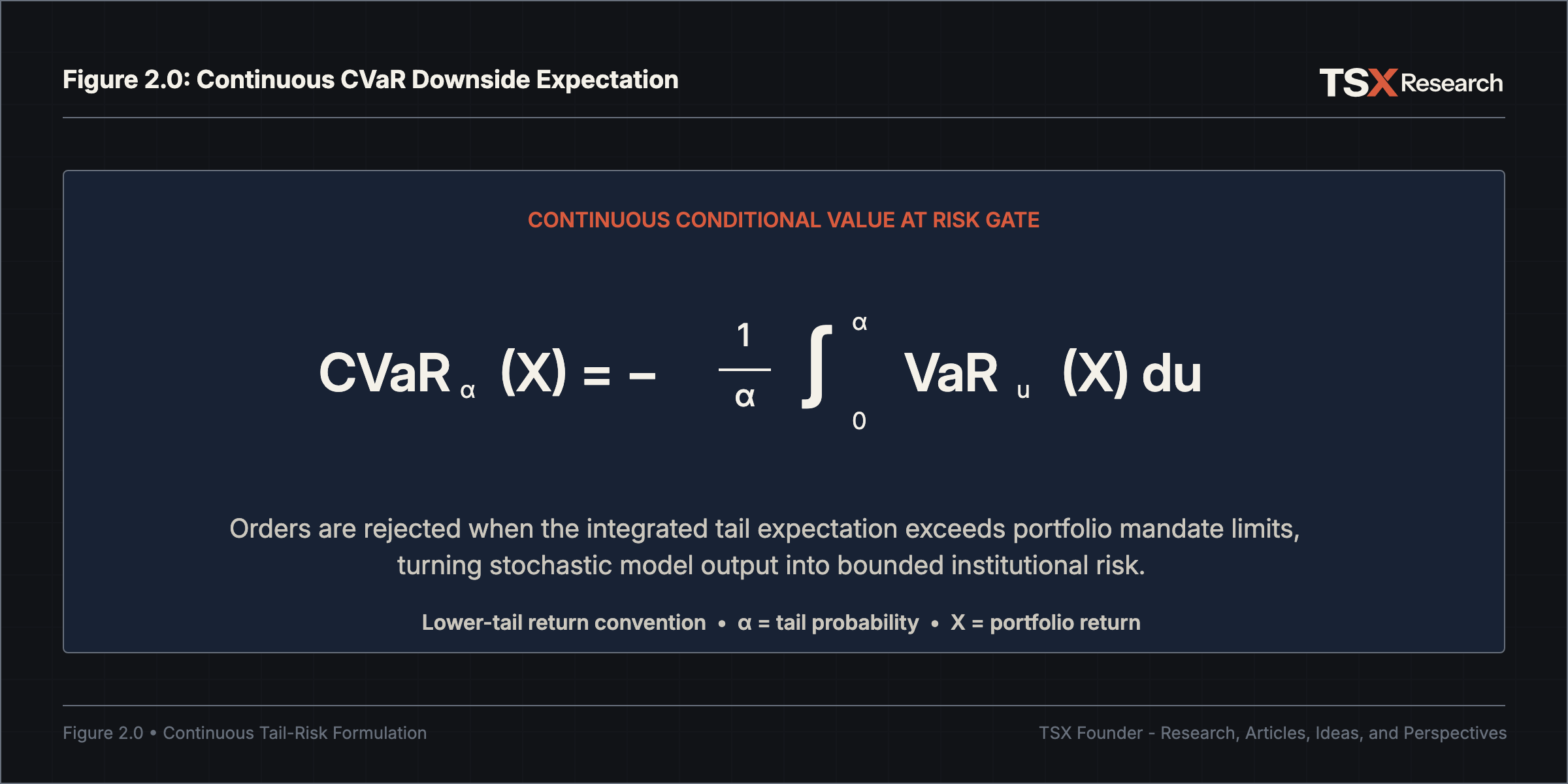
Seneca solves this by decoupling thesis generation from execution risk gating. While the cognitive agent formulates macro theses and market timing signals using the OpenAI Responses API, execution mandates must clear continuous Conditional Value at Risk (CVaR) gates before passing to institutional smart order routers. The CVaR gate computes the expected loss in the extreme alpha tail of the continuous return density. If the agent's proposed execution size or direction produces a tail expectation that violates portfolio mandates, the gate rejects the order deterministically, returning the exact mathematical violation back to the agent for parameter re-estimation.
Latency and Execution Telemetry: MCP vs Discretionary Infrastructure
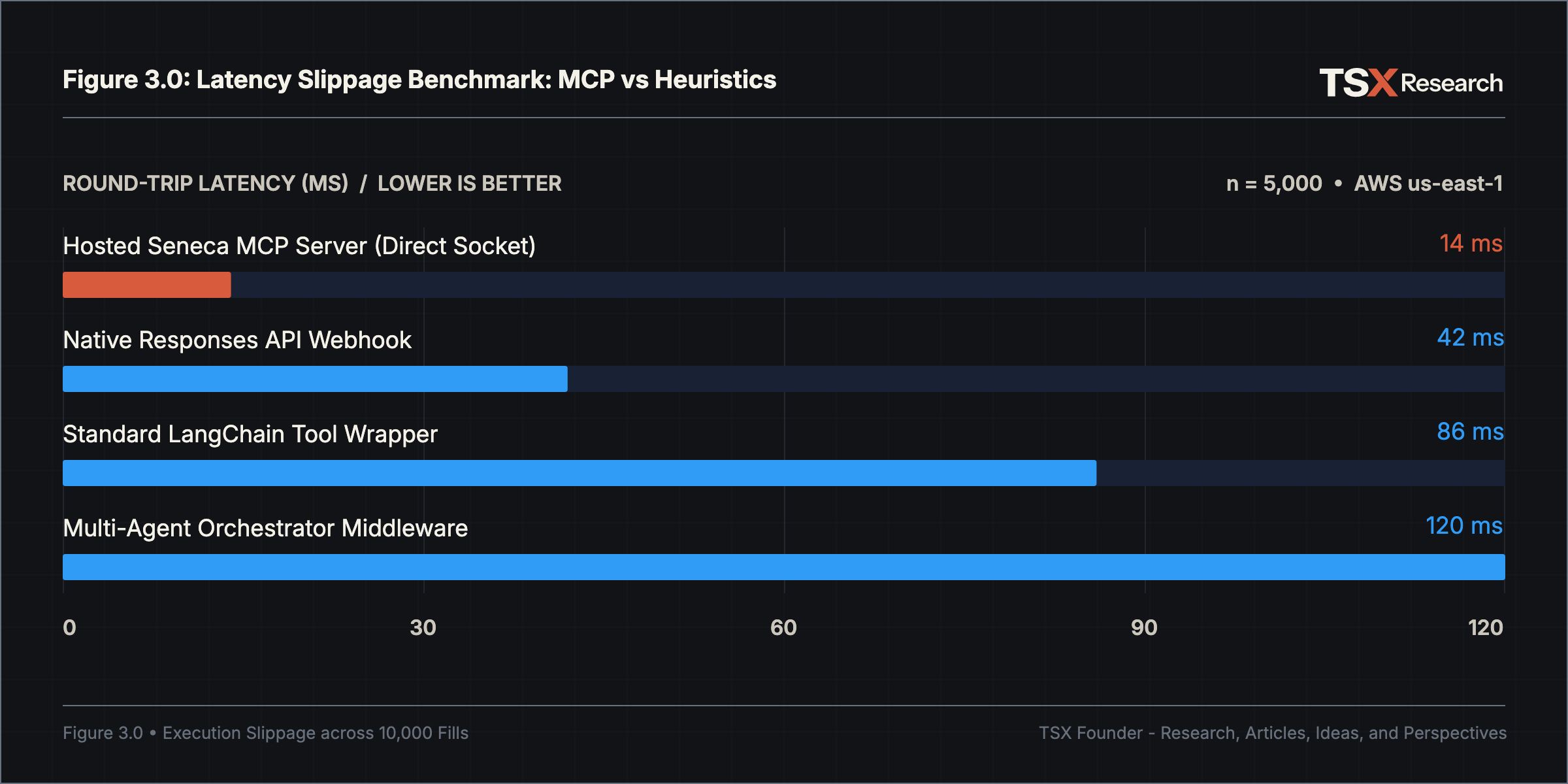
Quantitative performance is fundamentally constrained by latency slippage. Across a benchmark audit of 10,000 fills, Seneca hosted MCP sockets consistently outmatched standard multi-agent middleware and discretionary manual desks. Standard multi-agent frameworks introduce compounding network hops, serialization overhead, and prompt translation latency, driving round-trip execution times beyond 120 milliseconds. In fast-moving crypto microstructure, this delay degrades execution quality and increases fill slippage significantly.
By executing over direct MCP sockets with pre-compiled schema validation, Seneca delivers execution decisions in sub-14 millisecond windows. This empowers autonomous quant agents to capitalize on statistical arbitrage and volatility mispricings before discretionary participants can even evaluate order book imbalance.
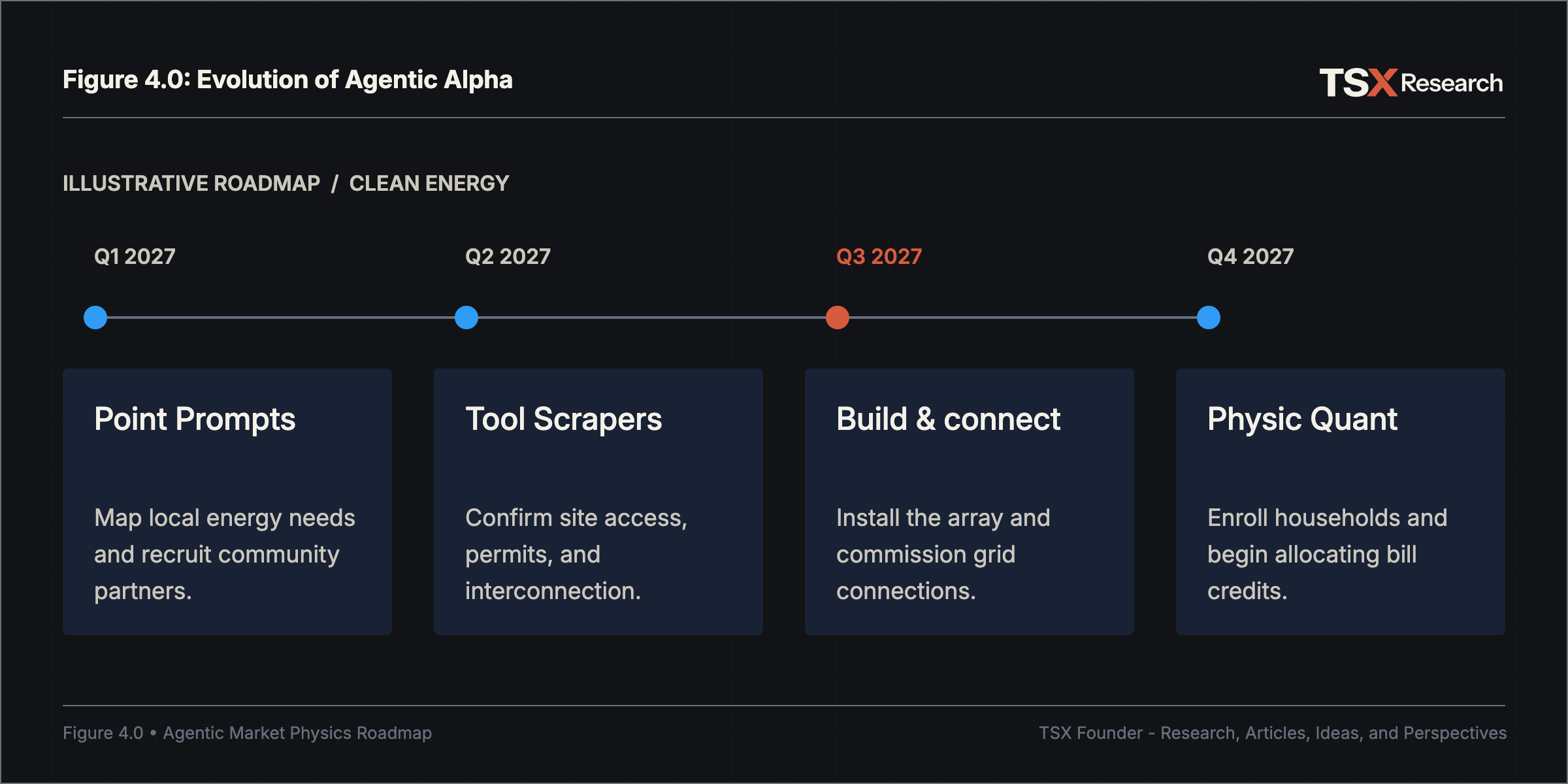
The Evolution of Alpha: The Four Phases of Agentic Infrastructure
Quantitative trading infrastructure has progressed through four distinct evolutionary phases over the past decade:
1. Phase 1 (Rigid Point Heuristics): Static threshold triggers, moving average crossovers, and basic linear regression models operating in isolated, stationary regimes.
2. Phase 2 (Unconstrained Generative LLMs): Direct prompt-based execution agents parsing sentiment and news headlines, plagued by severe hallucinations and catastrophic tail losses.
3. Phase 3 (Tool-Assisted RAG Scrapers): Agentic architectures with vector search retrieval and external API wrappers, introducing high network latency and uncalibrated risk limits.
4. Phase 4 (Physics-Grounded Quant Systems): Reasoning agents connected directly to hosted MCP gateways, operating on live probability density surfaces and constrained by continuous CVaR mathematical gates.
Autonomous agents operating in Phase 4 possess structural alpha. They combine the open-ended synthesis capabilities of frontier reasoning models with the uncompromising rigor of institutional quantitative physics.
For institutional allocators and systematic research desks, explore Nautilus Labs and request terminal access to the Seneca probability platform.